Timothy Price
American PsychoTimothy Price is one of Patrick Bateman’s closest companions and a sharply drawn representative of the Wall Street yuppie culture surrounding Pierce & Pierce. Twenty-six, financially privileged, aggressively ambitious, and obsessed with clothing, restaurants, clubs, and professional status, Price converts nearly every social encounter into a complaint or a competition. His importance lies not in a conventional moral or psychological transformation but in the way his restless voice and flamboyant behavior mirror the novel’s larger world: polished on the surface, terrified underneath, and unable to recognize suffering except as another spectacle.
Identity and Social Position
Price is associated with Pierce & Pierce and presents himself as an indispensable product of elite education and corporate ambition. In a cab leaving Wall Street, he insists that he is resourceful, creative, young, unscrupulous, highly motivated, and highly skilled, concluding that society cannot afford to lose him because he is an asset. His professional self-description is less a confession of vocation than a sales pitch, a rehearsed inventory of qualities whose value he measures in market terms. He complains that everyone hates their work and that he and Patrick are not making enough money, while treating his education and employment as investments that ought to yield a more luxurious life.
His privilege is made visible through possessions and access. He has a cooperative apartment in New York City and a place in The Hamptons, wears an Ermenegildo Zegna suit with an Ike Behar shirt, Ralph Lauren tie, and Fratelli Rossetti shoes, and carries an expensive Walkman, a Tumi calfskin attaché case, and a Panasonic cordless telephone. These details do not establish individuality so much as membership in a carefully maintained class uniform. At Evelyn Richards’s brownstone, he wears a Versace tie and exchanges the same practiced air-kiss with Courtney Lawrence that Patrick receives, participating effortlessly in the rituals of a social world where manners, brands, and access function as proof of belonging.
Complaints and Worldview
Price’s defining activity is complaint. In the cab he condemns New York City as filthy and diseased, scanning the city through reports of strangled models, murdered children, AIDS, homelessness, traffic, collapsing buildings, and other disasters. He keeps count of the beggars he has seen and announces that the man at a corner is the twenty-fourth that day. The precision of the count gives his disgust a bureaucratic form: suffering becomes data, and the city’s poor become an accumulating nuisance rather than people.
His anxiety about disease is similarly expansive and absurd. He lists illnesses that he believes might be transmitted through sexual contact with someone infected with AIDS, extending the fear until Patrick corrects him that dyslexia is not a virus. The exchange reveals more than ignorance. Price’s imagination treats the body, the city, and social decline as contaminated systems, while his own response is not solidarity or responsibility but escalating panic and disgust. The homeless, the sick, and the visibly vulnerable appear to him as evidence that the environment has failed to preserve the clean, controlled lifestyle he expects.
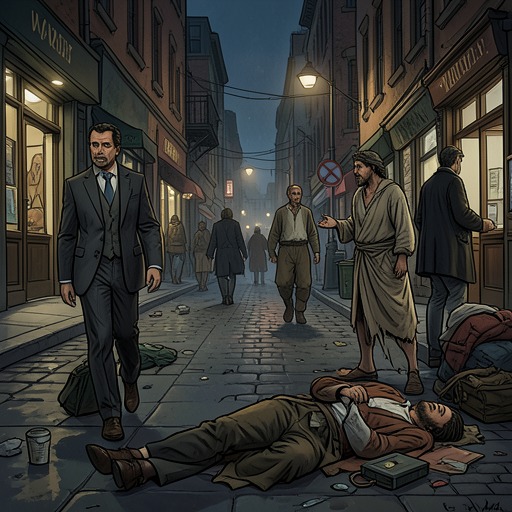
Price’s fixation on presentation also makes his complaints self-contradictory. He criticizes the city’s filth while measuring himself through expensive clothing, branded accessories, and elite venues. At Pastels, he participates in an evening whose bill totals $475, then objects to paying his full share for a scallop sausage appetizer. Outside the restaurant, a homeless man asks first for change and then, more hopefully, for food; Price answers the scene with mockery, and David Van Patten waves a one-dollar bill in front of another homeless man before pocketing it and entering Tunnel. Price belongs to a group that can move directly from conspicuous consumption to contempt for poverty without recognizing the moral connection between the two spaces.
Performance, Competition, and Recklessness
Price’s social behavior is theatrical even when he is merely complaining. At Courtney’s gathering he is part of a polished display of clothing, gestures, music, and professional familiarity. In another restaurant scene, Patrick’s new business card becomes an object of competitive attention, and Price treats it as though it might be a packet of drugs before learning that it is a status display. His response confirms the group’s hierarchy: objects matter because they provoke recognition, envy, or amusement, not because they have practical use.
At Tunnel, Price’s performance becomes physically dangerous. The club is crowded with men in tuxedos, while a homeless man sits near a Dumpster outside the ropes begging for change. Once inside, Price handles the doormen and secures drink tickets and VIP Basement passes, apparently through money or influence. The access is part of his authority: he can convert wealth and reputation into movement through spaces that exclude others.
Later, with the club over capacity and the crowd trapped in strobe light, smoke, and loud music, Price climbs onto the railing while holding a champagne glass. He stretches out both arms and closes his eyes as if blessing the crowd. Patrick watches him from within the mass of people, embarrassed but also unwilling to intervene. During a brief break in the noise, Price shouts farewell and insults the crowd, then twists over the railing, leaps onto the tracks, and runs into the darkness with the champagne flute still in his hand. He stumbles but recovers, while a security guard remains idle. The scene turns privileged recklessness into a grotesque spectacle: Price’s wealth grants him entrance, but his desire to dominate the room drives him beyond its boundaries.
Relationships and Group Function
Price is embedded in Patrick’s male social circle, alongside David Van Patten, Craig McDermott, and Luis Carruthers. Patrick notices when Price ignores Luis at the bar, a small act that reinforces the group’s hierarchy and Luis’s marginal position. Price’s indifference is not an isolated personality trait; it is one of the mechanisms by which the circle decides who counts as socially legible. He is confident among men who share his codes of dress and consumption, while those who fail to perform those codes become objects of ridicule or neglect.
He also participates in the group’s constant evaluation of food, clothing, reservations, and acquaintances. At Evelyn Richards’s home he complains about the cab and worries about the restaurant reservation. At Pastels he helps turn the bill into another test of status and money. At Tunnel he assumes that access can be negotiated. Even leisure is organized as a series of transactions, and Price’s friendships therefore resemble business relationships: each person provides entertainment, credentials, connections, or an audience for another person’s performance.
Price’s relationship with Patrick is especially revealing because Patrick alternates between irritation, observation, and identification. Patrick records Price’s speeches, notices his clothes, and follows his movements through restaurants and clubs, yet also shares the same consumer environment and competitive masculine codes. Price’s complaints give voice to anxieties Patrick rarely expresses so openly, while Price’s theatrical excess anticipates the instability that later defines Patrick’s own narration. The two men are not opposites; they are variations on the same social type, with Price’s public flamboyance set against Patrick’s more controlled and increasingly violent interiority.
Disappearance and Return
The book repeatedly places Price beside stories of unexplained disappearance and suspected violence. During one of his rants, a newspaper reports that two people vanished at a party aboard a yacht while the boat circled the island; the only clues are spattered blood and three smashed champagne glasses, and police suspect a machete but have no bodies or suspects. The report functions as part of the same media environment that Price consumes and repeats, where murder is another item among traffic, disease, celebrities, and urban disorder.
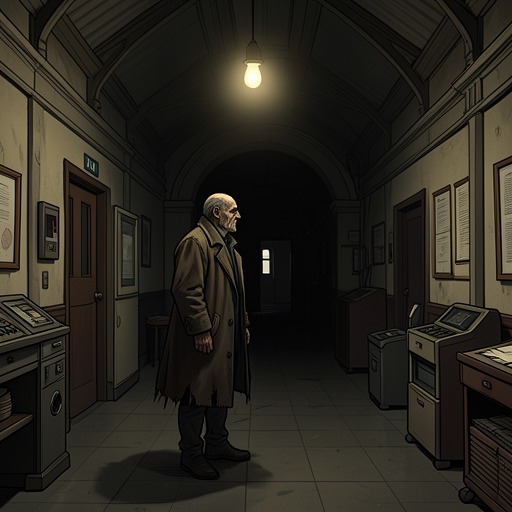
After the Tunnel episode, Price’s status becomes uncertain. Much later, while Patrick sits in his office crossing out days on a calendar, Jean announces that Price wants to speak with him. Patrick is frightened and tells her to send him in. Price enters wearing another carefully selected outfit, including a Canali Milano wool suit, an Ike Behar shirt, a Bill Bless tie, and Brooks Brothers shoes. Apart from a possible smudge on his forehead, he looks remarkably fit. When Patrick asks where he has been, Price answers that he has merely been making the rounds and says that he is back.
The return is deliberately underexplained. It neither confirms what happened at Tunnel nor provides a stable account of Price’s whereabouts. Patrick’s uncertainty about whether Price has truly resurfaced extends the novel’s unreliable narration into the social world: people may be interchangeable, events may be misrecognized, and apparent consequences may dissolve into ordinary conversation. Price can vanish into darkness and reappear in an office without explanation because the culture around him is already structured to absorb discontinuity. His polished identity survives without requiring a coherent history.
Narrative and Thematic Significance
Price embodies the contradiction between elite self-importance and social uselessness. He calls himself an asset while treating work as hateful, wealth as insufficient, and the suffering city as a contaminated backdrop. His material advantages do not produce security. Instead, they intensify his need to display control through clothes, reservations, money, complaints, and public performance. The more insistently he asserts his value, the more clearly the novel shows a society in which people are judged by interchangeable signs.
His movement through New York City also maps the city’s sharp social divisions. He travels from Wall Street in a private cab, through expensive restaurants and clubs, into spaces policed by doormen, and past beggars whose poverty remains visible but socially sealed off. At the same time, Patrick later walks through empty streets, garbage, abandoned storefronts, and the homeless man with Gizmo, while Central Park and its zoo become settings for fantasies and acts of violence. Price does not bridge these zones; he crosses them as a consumer moving between controlled environments, leaving exclusion and humiliation behind him.
Price’s disappearance and return finally make him a structural double for Patrick. Both men are sustained by surfaces, names, clothing, and professional identities; both inhabit a world where the same stories, faces, and brands circulate endlessly; and both remain insulated from the consequences of what they say and do. Price’s flamboyant escape onto the tracks looks like a moment of rupture, but his later reappearance suggests that even rupture can be absorbed by the system. He is not transformed by the darkness he enters. He simply returns to the performance, apparently intact.